Polymorphic Serialization in .NET: OpenAPI Discriminators in Action
Learn how to implement polymorphic JSON serialization in .NET using OpenAPI discriminators and `System.Text.Json`.
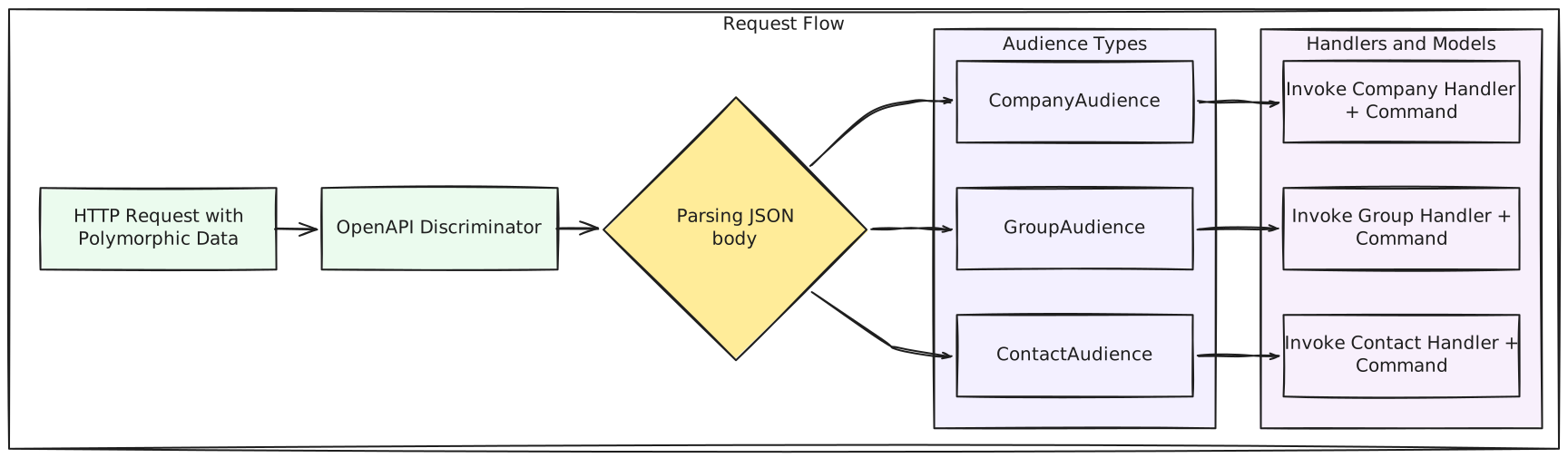
With each new version of .NET, developers gain access to more powerful new features that streamline complex tasks. One such feature is the ability to handle polymorphic data in HTTP requests for dynamic APIs. Here we explore how to achieve this using OpenAPI Discriminator Objects and .NET’s System.Text.Json library.
On the Contract Side
The OpenAPI specification includes a powerful feature called Discriminator Object. It helps to describe complex API contracts with more than one of the component schemas and associate the possible values of a named property with alternative schemas. This is especially useful when dealing with dynamic data structures for serialization and deserialization.
The discriminator is supported in schema definitions only when using the composite keywords oneOf, anyOf, and allOf.
| Composite Keyword | Validation Behavior | Typical Use Case |
|---|---|---|
oneOf | Value must match exactly one subschema. | Selects a single subtype for an object or array item. |
allOf | Value must match all subschemas. | Combines multiple schemas; discriminator can help resolve type when subschemas overlap. |
anyOf | Value must match any (one or more) subschemas. | Allows flexible matching; discriminator resolves which subtype applies for each item. |
The basic implementation involves placing the discriminator object alongside these keywords, allowing to determine the target schema to use during serialization and deserialization.
This approach could be useful for both single object properties and arrays. For single objects, it helps to selects the correct subtype of the property. For arrays, each item uses the discriminator to resolve its type, enabling to hold different subtypes within the same array definition.
1
2
3
4
5
6
7
8
9
10
11
12
13
14
15
16
17
18
19
20
21
22
23
24
25
26
27
28
29
30
31
32
33
34
35
36
components:
  schemas:
    ShareDocumentRequest:
      type: object
      required:
        - documentId
        - ownerId
        - access
        - audience
      properties:
        documentId:
          type: string
          format: uuid
          description: ID of the document being shared
        ownerId:
          type: string
          format: uuid
          description: ID of the document owner
        access:
          type: string
          enum: [read, write]
          description: Access rule for the shared document
        audience:
          type: array
          description: List of audiences to share the document with
          items:
            oneOf:
              - $ref: '#/components/schemas/CompanyAudience'
              - $ref: '#/components/schemas/GroupAudience'
              - $ref: '#/components/schemas/ContactAudience'
            discriminator:
              propertyName: type
              mapping:
                company: '#/components/schemas/CompanyAudience'
                groups: '#/components/schemas/GroupAudience'
                contacts: '#/components/schemas/ContactAudience'
The audience property is defined as an array of polymorphic objects, where each array item can represent a different audience type, enabling a document to be shared in a single request with multiple audience types.
The propertyName specified in the discriminator object refers to a property that is used to select the schemas listed under oneOf. By default, the value of the property is matched to a schema name from the list and defined under components/schemas.
If a mapping is provided, it overrides the default behavior by mapping specific values to either a different schema name or a schema identified by a URI. If a mapping value could be interpreted as both a schema name and a URI, it’s up to the implementation to decide, but it’s recommended to treat it as a schema name.
1
2
3
4
5
6
7
8
9
10
11
12
13
14
15
16
17
18
19
20
21
22
23
24
25
{
  "documentId": "11111111-1111-1111-1111-111111111111",
  "ownerId": "aaaaaaaa-bbbb-cccc-dddd-eeeeeeeeeeee",
  "access": "read",
  "audience": [
    {
      "type": "company",
      "companyId": "123e4567-e89b-12d3-a456-426614174000"
    },
    {
      "type": "group",
      "groupIds": [
        "987e6543-e21b-12d3-a456-426614174111",
        "987e6543-e21b-12d3-a456-426614174222"
      ]
    },
    {
      "type": "contact",
      "contactIds": [
        "555e1234-e89b-12d3-a456-426614174999",
        "555e1234-e89b-12d3-a456-426614175000"
      ]
    }
  ]
}
The example JSON schema represents a request for sharing a document with different types of audience. The polymorphism applies to the items within the audience array where each item can have a distinct structure according to its type.
On the Backend Side
Starting with .NET 7, the System.Text.Json namespace provides functionality that supports polymorphic type hierarchy serialization and deserialization with attribute annotations.
1
2
3
4
5
6
7
8
9
10
11
[JsonPolymorphic(TypeDiscriminatorPropertyName = "type")]
[JsonDerivedType(typeof(CompanyAudience), nameof(AudienceType.Company))]
[JsonDerivedType(typeof(GroupAudience), nameof(AudienceType.Group))]
[JsonDerivedType(typeof(ContactAudience), nameof(AudienceType.Contact))]
public abstract class Audience
{
    [JsonPropertyName("type")]
    public AudienceType Type { get; set; } // discriminator property is optional
}

public enum AudienceType { None, Company, Group, Contact }
Using the provided annotations, you can customize the discriminator name and declare mapping of the subtype to the discriminator property key value, just like in the contract definition.
By default, the discriminator name is $type, and the base type may omit the matching property. Parameter values in attributes are case-sensitive, and the discriminator value can be either an integer or a string. Mixing both types is technically possible but not recommended, as it can lead to confusion and potential deserialization issues.
1
2
3
4
5
6
7
8
9
10
11
12
13
14
15
16
17
18
19
20
21
22
23
24
25
26
public class CompanyAudience : Audience
{
    public Guid CompanyId { get; set; }

    // Uses an external service to check company status
    public override bool SatisfiesPolicy(ICompanyDirectoryService service) =>
        service.GetCompanyType(CompanyId) is CompanyType.Subsidiary or CompanyType.Parent;
}

public class GroupAudience : Audience
{
    public List<Guid> GroupIds { get; set; }

    // Uses an external service to check if all groups are private
    public bool AreAllPrivate(IGroupInfoService infoService) =>
        GroupIds.All(id => infoService.GetGroupVisibility(id) == GroupVisibility.Private);
}

public class ContactAudience : Audience
{
    public List<Guid> ContactIds { get; set; }

    // Uses an external service to check if all contacts are internal
    public bool AreAllInternal(IContactDirectoryService service) =>
        ContactIds.All(id => service.IsInternalContact(id));
}
Each derived type might implement its own properties, methods, and business logic required to fulfill the requirements and ensure single responsibility of your code. With polymorphic serialization, you can deserialize the audience array into a collection of strongly-typed objects, each casted to a dedicated audience type and processed by a command handler.
1
2
3
4
5
6
7
8
9
10
11
12
13
14
15
16
17
18
19
20
21
22
23
24
25
26
27
28
29
30
31
32
public interface ICommandHandler<T>
{
    Task HandleAsync(Guid document, T audience, CancellationToken cancellationToken);
}

public class DocumentShareDispatcher(IServiceProvider serviceProvider)
{
    public async Task DispatchShareRequest(
      ShareDocumentRequest request,
      CancellationToken cancellationToken = default)
    {
        foreach (var audience in request.Audience)
        {
            await (audience switch
            {
                CompanyAudience company => serviceProvider
                    .GetService<ICommandHandler<CompanyAudience>>()!
                    .HandleAsync(request.DocumentId, company, cancellationToken),

                GroupAudience group => serviceProvider
                    .GetService<ICommandHandler<GroupAudience>>()!
                    .HandleAsync(request.DocumentId, group, cancellationToken),

                ContactAudience contact => serviceProvider
                    .GetService<ICommandHandler<ContactAudience>>()!
                    .HandleAsync(request.DocumentId, contact, cancellationToken),

                _ => throw new InvalidOperationException("Unknown audience type.")
            });
        }
    }
}
An alternative design, not leveraging polymorphic serialization attributes, would require implementing a custom JSON converter for the base type or working around with exposing a single raw JSON property. This complicates request validation and increases the need for boilerplate code.
1
2
3
4
5
6
7
8
9
10
11
12
13
14
15
16
17
18
19
20
21
22
23
24
25
26
27
28
29
30
31
32
33
34
35
36
37
38
39
40
41
42
43
44
45
46
// ...existing code...
public enum AudienceType { None, Company, Group, Contact }

public class AudienceJsonConverter : JsonConverter<Audience>
{
    public override Audience? Read(ref Utf8JsonReader reader, Type typeToConvert, JsonSerializerOptions options)
    {
        using var doc = JsonDocument.ParseValue(ref reader);
        var root = doc.RootElement;
        var type = root.GetProperty("type").GetString();

        return type switch
        {
            nameof(AudienceType.Company) => JsonSerializer.Deserialize<CompanyAudience>(root, options),
            nameof(AudienceType.Group)   => JsonSerializer.Deserialize<GroupAudience>(root, options),
            nameof(AudienceType.Contact) => JsonSerializer.Deserialize<ContactAudience>(root, options),
            _ => throw new JsonException($"Unknown audience type: {type}")
        };
    }

    public override void Write(Utf8JsonWriter writer, Audience value, JsonSerializerOptions options)
    {
        switch (value)
        {
            case CompanyAudience company:
                JsonSerializer.Serialize(writer, company, options);
                break;
            case GroupAudience group:
                JsonSerializer.Serialize(writer, group, options);
                break;
            case ContactAudience contact:
                JsonSerializer.Serialize(writer, contact, options);
                break;
            default:
                throw new JsonException($"Unknown audience type: {value?.GetType().Name}");
        }
    }
}

// Register the converter in your options
var options = new JsonSerializerOptions {
    Converters = { new AudienceJsonConverter() }
};

// Usage example
var audiences = JsonSerializer.Deserialize<List<Audience>>(json, options);
Conclusion
This design offers several significant benefits:
- Ease of Extensibility: Supporting new audience types is straightforward. Developers can add a new derived class and update the OpenAPI schema without requiring significant refactoring.
- Cleaner Domain Model: The use of polymorphism ensures that the domain model remains clean, making it easier to understand and maintain.
- Focus on Business Flow: Developers can dedicate their efforts to implementing the business logic rather than spending time on custom converters or manual data transfer object (DTO) mapping.
- Support for Batch Operations: The polymorphic approach enables handling multiple audience types in a single request, simplifying batch operations and extending API capabilities.
However, this approach is not without its drawbacks:
- Increased Complexity in Schema Management: The OpenAPI schema becomes more complex due to the use of the
discriminatorproperty and the need for precise mappings on both sides. - Runtime Deserialization Errors: If the discriminator mapping is not implemented correctly or if there are mismatches in case sensitivity, deserialization issues will occur only at runtime.
- Increased Learning Curve: The broader use of abstractions brings a challenge for newcomers to understand the concept and start contributing into the system.
By weighing these benefits and drawbacks, you can determine whether the polymorphic approach aligns with your project’s requirements and priorities. While it simplifies handling polymorphic data and enhances code maintainability, careful attention must be given to schema accuracy and runtime behavior.
Useful Links
- OpenAPI Data Modeling Techniques: Composition and polymorphism in OpenAPI.
- OpenAPI Discriminator Object: Details on using the discriminator object in OpenAPI schemas.
- System.Text.Json and Polymorphism: Official documentation on polymorphic serialization in .NET.
- Contract Model Configuration: Configure polymorphism without attribute annotations using the contract model.
- Custom Converter Patterns: Guide to creating custom JSON converters.
- Polymorphic Deserialization: Techniques for handling polymorphic deserialization.