Lean: Streamlining Software Production
Lean methodology focuses on maximizing customer value while minimizing waste, originating from Toyota's production system in the 1950s.
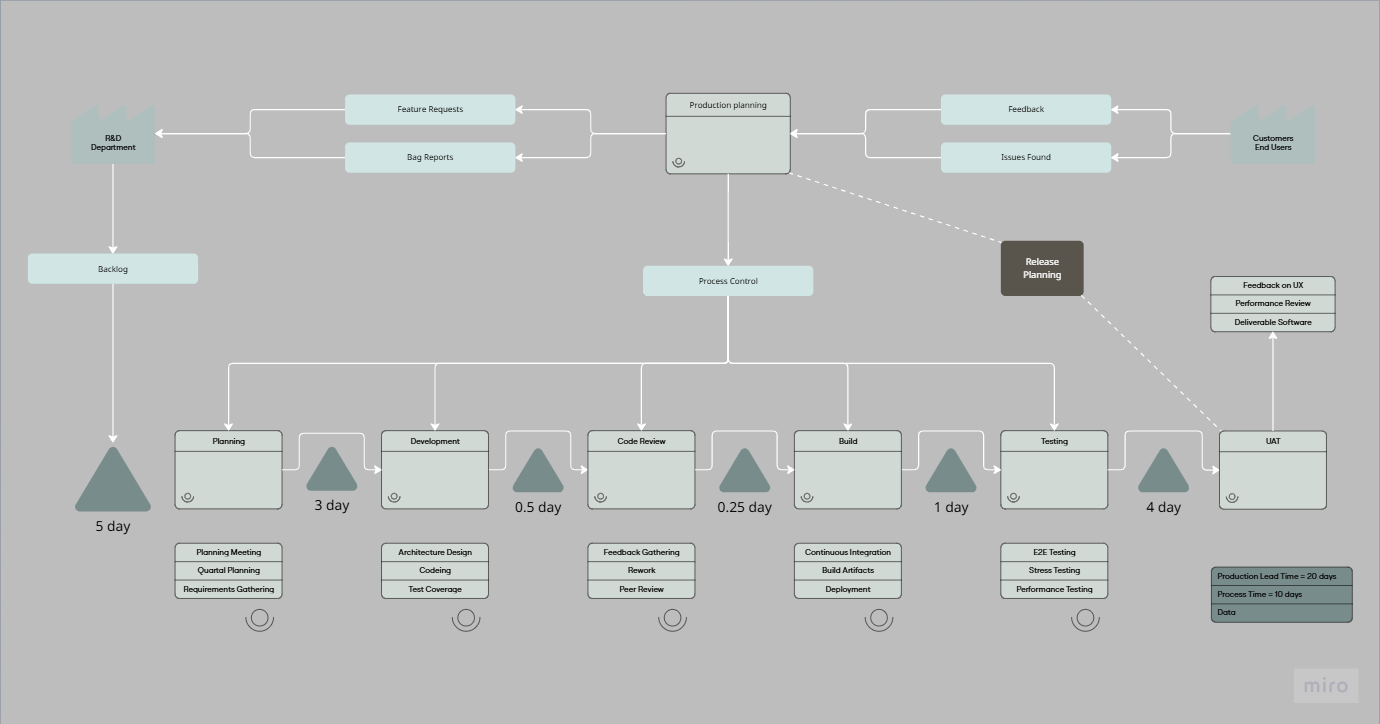
The main idea behind Lean methodology is to maximize customer value while minimizing waste, ensuring that every step in the production or development process contributes meaningfully to the final product. Before Lean, manufacturing was dominated by Henry Ford’s flow production system. Ford’s approach revolutionized mass production with lined-up fabrication, but it lacked flexibility and resulted in a limited variety of products – making it difficult to rapidly adapt to changing customer needs.
Lean originated in the 1950s from Toyota’s response to the limitations of Ford’s linear approach. Toyota reimagined manufacturing by shifting the focus from optimizing individual machines to optimizing the entire flow of products through the process. They pioneered innovations such as right-sizing machines for actual production volume, self-monitoring for quality, sequencing machines by process, enabling quick setups for small batches, and implementing pull-based production — where each process step signals the previous step for the needed materials. These innovations influenced software development, where production speed to release and responsiveness to customer needs are vital.
These changes enabled Toyota to achieve high efficiency, rapid response to market needs, low cost, high variety, and high quality, fundamentally improving flow-based production.
Core Principles
From the lessons learned in Toyota’s Lean manufacturing, five core principles define the methodology:
- Specify Value. Identify value from the end customers’ perspective.
- Identify the Value Stream. Enlist all process steps required to deliver the solution and eliminate those steps that do not create value for the end customer.
- Process Flow. Establish sequential phase-gated flow of the value-creating steps so that the product will flow smoothly toward the customer.
- Pull. Let customers pull value from you by requesting a new feature or buying a product.
- Continuous Improvement. Pursue perfection by continuously collecting customers’ feedback and solving issues in terms of minimizing time, cost, and waste.
In software development, these principles translate into a focus on customer needs (identify value), adapting the production process to these needs (map value streams), establishing only value-adding steps from identifying requirements to the final release (create flow), minimizing waste of overproduction by reacting to customer needs (establish pull), and seeking perfection via continuous improvement.
In 2007, Womack and Jones simplified these principles into three key elements:
- Purpose: Correctly specify the value that the customer seeks in order to cost-effectively solve their problems and identify the greatest value to provide. For software, this means prioritizing features that make a real difference for users.
- Process: Once purpose is clarified, focus on the process (value stream) used to achieve the objective. Ensure every step adds customer-visible value and delivers high, durable quality. Remove rituals or steps that disrupt rather than help teams achieve their goals.
- People: Assign responsibility for each value stream. Value-stream managers engage and align efforts across teams to move steadily toward the customer and elevate performance to ever-better states. In software, this could mean organizing teams around business domains, led by experts in both development and business for effective collaboration.
Key Practices
A cornerstone practice of Lean software development is Value Stream Mapping. This practice is central to continuous improvement: it is used before, during, and after a product release to identify waste and drive process improvements. By mapping the entire flow, teams can see the big picture of product development—revealing areas where, for example, issues in implementing certain requirements may cause other teams to adjust their plans, and what actions are needed to deliver the product.
Value Stream Mapping typically begins with the creation of a current state map. This involves capturing the actual condition of the value stream’s material and information flow, providing an honest look at how work is currently done. Once the current state is visualized, the team develops a future state map—a target image of how material and information should flow through the value stream to achieve optimal efficiency and value delivery.
This iterative process repeated over time is one of the simplest and best ways to teach yourself and your team to truly see where value is created (or lost). Although most commonly associated with Lean manufacturing and Lean Thinking and Practice, value stream mapping can be applied in any industry. Managers and teams outside manufacturing can also benefit greatly from using it to optimize their workflows and collaboration.
Self-monitoring for quality was implemented via Jidoka, an automated mechanism that stops the line when a defect is detected, reducing the need for manual checks. This approach allowed teams to address issues and receive quality feedback early, minimizing downstream issues and the high cost of late fixes. In software, the parallel is a multi-stage CI/CD pipeline including unit, integration, and end-to-end testing, which provide early automated quality signals throughout the software development life cycle.
Strengths and Benefits
Lean’s benefits are both practical and strategic:
- Customer-driven development: Lean is designed to follow the customers’ needs. The methodology puts customer feedback at the center of the process, requiring teams to seek and act on end-user insights for every iteration. This ensures the product evolves in direct response to what customers truly value.
- Continuous improvement: One of Lean’s hallmarks is its commitment to ongoing enhancement. Teams are expected to analyze results, identify inefficiencies or waste, and immediately restart the improvement cycle—continuously refining processes and products throughout the entire life of the product family.
- Waste reduction and production optimization: The greatest benefit of Lean is its intense focus on reducing waste—whether in time, resources, or effort—and optimizing production. Such optimization is not limited to any specific phase; it can happen at any moment, allowing for rapid adjustments and resource savings.
- Built-in quality assurance: Lean’s process expects that the next step is not started until high quality is achieved in the current step. This integrated approach to quality ensures that value delivered to the customer is consistently high, reducing rework and defects.
- Agility across cooperating teams: Lean encourages analysis not just at the end of the release cycle but throughout development. As soon as a product is completed, all stakeholders—internal or external—should analyze outcomes and set new goals, adapting the process to fit changing customer needs.
Challenges and Considerations
Lean also presents explicit challenges that teams should be aware of:
- Delayed customer engagement: Although Lean values customer needs, the methodology is structured to complete the entire development cycle before presenting the product to the customer. This can mean there is little to show and limited opportunity to gather customer feedback until the product is finally delivered—potentially delaying crucial insights.
- Potential for overemphasis on perfection: Lean’s pursuit of perfection, while intended to ensure quality, can act as a bottleneck. Teams may feel blocked from moving forward unless every detail meets a high standard—even when such rigor might not be necessary for the context or stage of development.
- Manufacturing roots may not always fit software: Lean was originally developed for manufacturing, where physical flow and inventory are key factors. In software, direct analogs may be harder to apply, and teams may struggle to interpret Lean concepts in a digital context. However, the methodology’s core principles can still help teams regain focus when they face inefficiency due to too many tasks or distractions.
- Requires cultural and process discipline: Successful Lean adoption demands strong commitment across the organization. Teams must be disciplined in identifying and eliminating waste and in reflecting on their practices, which can be difficult to sustain—especially in fast-moving or poorly aligned environments.
Conclusion
Lean methodology offers a powerful framework for maximizing customer value while minimizing waste. Its principles and practices, refined over decades from Toyota’s manufacturing innovations, have proven applicable to software development and many other industries. Lean requires cultural commitment and may not fit every project perfectly. Its focus on continuous improvement, value stream optimization, and customer-centric development makes Lean a valuable approach for teams seeking to deliver high-quality products efficiently at lower costs.
Useful Links
- Womack and Jones 1996: Lean Thinking : Banish Waste and Create Wealth in Your Corporation.
- Lean Thinking and Practice: Core concepts of Lean thinking.
- Value Stream Mapping: Guide to mapping and optimizing value streams.
- Lean Software Development by Mary and Tom Poppendieck: Comprehensive guide to applying Lean principles in software development.