Comparing Lean, Waterfall, and Agile Methodologies
A side-by-side comparison of Lean, Waterfall, and Agile methodologies to help choose the right approach for your software project.
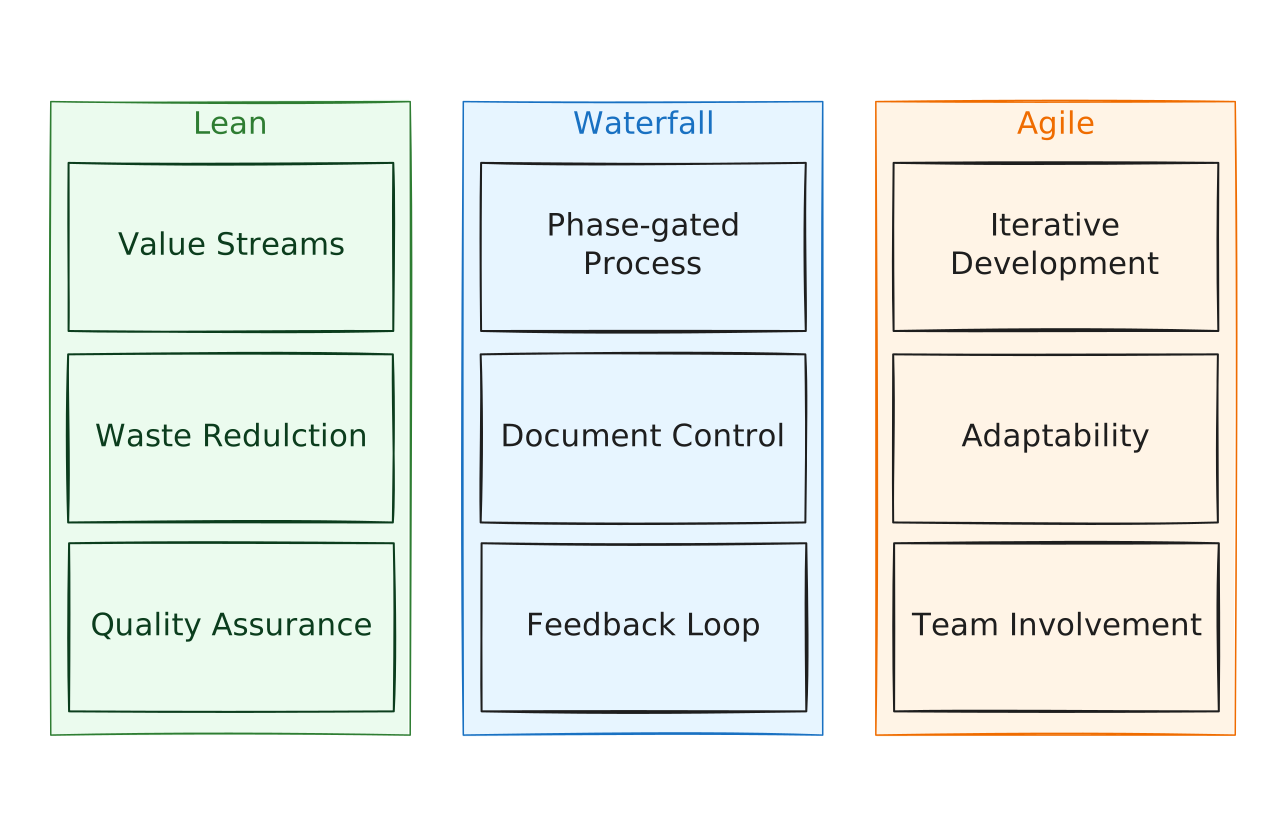
In the ever-evolving landscape of software development, choosing the right methodology can make or break a project. Three prominent approaches—Lean, Waterfall, and Agile—each offer distinct philosophies and practices, impacting how teams deliver value, respond to change, and optimize their work. This post explores the origins, core principles, strengths, and challenges of these methodologies to help you decide which is best for your next project.
Lean Methodology
The main idea behind Lean methodology is to maximize customer value while minimizing waste, ensuring that every step in the production or development process contributes meaningfully to the final product. Before Lean, manufacturing was dominated by Henry Ford’s flow production system. Ford’s approach revolutionized mass production with lined-up fabrication, but it lacked flexibility and resulted in a limited variety of products – making it difficult to rapidly adapt to changing customer needs.
Lean originated in the 1950s from Toyota’s response to the limitations of Ford’s linear approach. Toyota reimagined manufacturing by shifting the focus from optimizing individual machines to optimizing the entire flow of products through the process. They pioneered innovations such as right-sizing machines for actual production volume, self-monitoring for quality, sequencing machines by process, enabling quick setups for small batches, and implementing pull-based production — where each process step signals the previous step for the needed materials. These innovations influenced software development, where production speed to release and responsiveness to customer needs are vital.
Self-monitoring for quality was implemented via Jidoka, an automated mechanism that stops the line when a defect is detected, reducing the need for manual checks. This approach allowed teams to address issues and receive quality feedback early, minimizing downstream issues and the high cost of late fixes. In software, the parallel is multi‑stage CI/CD testing, including unit, integration, and end‑to‑end checks, which provide automated, early quality signals throughout the software development life cycle.
These changes enabled Toyota to achieve high efficiency, rapid response to market needs, low cost, high variety, and high quality, fundamentally improving flow-based production.
Core Principles
From the lessons learned in Toyota’s Lean manufacturing, five core principles define the methodology:
- Specify value from the standpoint of the end customer by product family.
- Identify all steps in the value stream for each product family, eliminating whenever possible those steps that do not create value.
- Make the value-creating steps occur in tight sequence so that the product will flow smoothly toward the customer.
- Let customers pull value from the next upstream activity as flow is introduced.
- Repeat the process until a state of perfection is reached, in which perfect value is created with no waste.
In software development, these principles translate into a focus on customer needs (identify value), varying the product to these needs (map value streams), establishing only value‑adding steps from identifying requirements to the final release (create flow), minimizing waste of overproduction by reacting to customer needs (establish pull), and seeking perfection via continuous improvement.
In 2007, Womack and Jones simplified these principles into three key elements—Purpose, Process, People:
- Purpose: Correctly specify the value that the customer seeks in order to cost-effectively solve their problems and identify the greatest value to provide. For software, this means prioritizing features that make a real difference for users.
- Process: Once purpose is clarified, focus on the process (value stream) used to achieve the objective. Ensure every step adds customer-visible value and delivers high, durable quality. Remove rituals or steps that disrupt rather than help teams achieve their goals.
- People: Assign responsibility for each value stream. Value-stream managers engage and align efforts across teams to move steadily toward the customer and elevate performance to ever-better states. In software, this could mean organizing teams around business domains, led by experts in both development and business for effective collaboration.
Key Practices
A cornerstone practice of Lean software development is Value Stream Mapping. This practice is central to continuous improvement: it is used before, during, and after a product release to identify waste and drive process improvements. By mapping the entire flow, teams can see the big picture of product development—revealing areas where, for example, issues in implementing certain requirements may cause other teams to adjust their plans, and what actions are needed to deliver the product.
Value Stream Mapping typically begins with the creation of a current state map. This involves capturing the actual condition of the value stream’s material and information flow, providing an honest look at how work is currently done. Once the current state is visualized, the team develops a future state map—a target image of how material and information should flow through the value stream to achieve optimal efficiency and value delivery.
This iterative process—repeated over time—is one of the simplest and best ways to teach yourself and your team to truly see where value is created (or lost). Although most commonly associated with Lean manufacturing and Lean Thinking and Practice, value stream mapping can be applied in any industry. Managers and teams outside manufacturing can also benefit greatly from using it to optimize their workflows and collaboration.
Strengths and Benefits
Lean’s benefits are both practical and strategic:
- Customer-driven development: Lean is designed to follow the customers’ needs. The methodology puts customer feedback at the center of the process, requiring teams to seek and act on end-user insights for every iteration. This ensures the product evolves in direct response to what customers truly value.
- Continuous improvement: One of Lean’s hallmarks is its commitment to ongoing enhancement. Teams are expected to analyze results, identify inefficiencies or waste, and immediately restart the improvement cycle—continuously refining processes and products throughout the entire life of the product family.
- Waste reduction and production optimization: The greatest benefit of Lean is its intense focus on reducing waste—whether in time, resources, or effort—and optimizing production. Such optimization is not limited to any specific phase; it can happen at any moment, allowing for rapid adjustments and resource savings.
- Built-in quality assurance: Lean’s process expects that the next step is not started until high quality is achieved in the current step. This integrated approach to quality ensures that value delivered to the customer is consistently high, reducing rework and defects.
- Agility across cooperating teams: Lean encourages analysis not just at the end of the release cycle but throughout development. As soon as a product is completed, all stakeholders—internal or external—should analyze outcomes and set new goals, adapting the process to fit changing customer needs.
Challenges and Considerations
Lean also presents explicit challenges that teams should be aware of:
- Delayed customer engagement: Although Lean values customer needs, the methodology is structured to complete the entire development cycle before presenting the product to the customer. This can mean there is little to show and limited opportunity to gather customer feedback until the product is finally delivered—potentially delaying crucial insights.
- Potential for overemphasis on perfection: Lean’s pursuit of perfection, while intended to ensure quality, can act as a bottleneck. Teams may feel blocked from moving forward unless every detail meets a high standard—even when such rigor might not be necessary for the context or stage of development.
- Manufacturing roots may not always fit software: Lean was originally developed for manufacturing, where physical flow and inventory are key factors. In software, direct analogs may be harder to apply, and teams may struggle to interpret Lean concepts in a digital context. However, the methodology’s core principles can still help teams regain focus when they face inefficiency due to too many tasks or distractions.
- Requires cultural and process discipline: Successful Lean adoption demands strong commitment across the organization. Teams must be disciplined in identifying and eliminating waste and in reflecting on their practices, which can be difficult to sustain—especially in fast-moving or poorly aligned environments.
References
Waterfall Methodology
Waterfall is one of the earliest formalized approaches to software development. Often linked to Winston W. Royce’s 1970 paper “MANAGING THE DEVELOPMENT OF LARGE SOFTWARE SYSTEMS”, Waterfall draws from traditional engineering disciplines where predictability, documentation, and phase gates mitigate risk in large, capital‑intensive initiatives (defense, aerospace, infrastructure) with clear goals and clear timelines.
Most of the time it is described as a rigid process of five sequential stages: Requirements, Design, Development, Testing, and Deployment, where each stage must be completed before the next stage can be started. This is true for the initial process Royce presented as a common but fundamentally flawed model, which is risky and invites failure due to its inability to address issues early. This is the diagram that was later named the “Waterfall Model”.
In comparison with the Lean methodology, the Waterfall process is focused on securing the requirements and documenting as much as possible at the cost of increasing the development time and resources, and introducing steps that do not bring value to the customer.
Core Principles
For the rest of the paper, Royce actually advocates introducing an iterative approach to this model, with the preceding and succeeding stages cooperating to provide early feedback. It includes the famous feedback arrows going back from each step to the previous ones, collecting and clarifying requirements to streamline further design and development, and the crucial step of building a “Preliminary Program Design” with substantial documentation before full-scale development.
It is often assumed that requirements can be collected and clarified once, in a dedicated phase, to streamline subsequent design and development. After the requirements are finalized, the team designs the target system before proceeding to coding. Design and development may include building prototypes to validate concepts at a smaller scale, challenge assumptions with fewer resources, and gather early feedback from stakeholders and end users. Prototyping also enables management to assess whether the allocated resources and schedule are sufficient to deliver the project within defined constraints. At this stage, the overall system is designed, and key decisions are made about technologies, algorithms, and data sources.
The intent is to uncover and resolve problems as early as possible by thoroughly inspecting and planning the software before any coding begins. Ignoring these practices pushes defect discovery to later stages and forces costly backtracking to earlier stages such as requirements and design. The resulting design changes can be so dramatic that the original requirements are violated, causing significant losses of time and resources.
Key Practices
In Royce’s model, “Waterfall” is a phase‑gated process with constant feedback between neighboring stages and reinforced by risk‑reduction practices.
Feedback loops between stages: Each stage (requirements, design, implementation, verification, operations) reviews outputs from the next and can send work back for correction. Teams and departments are supposed to collaborate to surface errors and correct them early at lower cost.
Preliminary program design: Produce a high‑level architecture, module decomposition, interfaces, data flow, and performance budgets before completing full analysis to validate feasibility and guide detailed work. The point is to establish preliminary constraints and challenge them during analysis, which precedes the next phase.
Document the design: Maintain specification‑driven artifacts like software requirements, software architecture, service‑to‑service contracts, test plans, and schedules. Produce thorough documentation that ultimately becomes the project’s specification and design. These artifacts enable development and quality assurance teams to understand every aspect of the system and collaborate effectively in later stages.
“Do it twice”: Build a pilot/prototype/simulation to validate architecture, technology choices, throughput/latency, and critical algorithms before committing to a full‑scale build. Today, we would call it a proof of concept implementing the primary features and key selling points as a prototype first and cancel the project if it doesn’t find an audience. This saves resources by avoiding projects that are unrealistic or not actually valuable to customers.
Plan, control, and monitor testing: Start involving testing early, ideally by planning the test process alongside the design phase. Such an approach helps to ensure that every logic path in the software is tested at least once by specialists who could do it properly. Organizing autonomous test groups may help in defining whether the documentation is prepared well enough to follow and to properly test the working software against the collected requirements.
Involve the customer: Make sure the customer is involved in the process at every key phase. The involvement can be formalized through a series of formal reviews during the design stage and requirements gathering, as well as prototype demos and the final acceptance review. This is intended to reduce ambiguity, avoid misunderstandings in requirements, and control scope with recorded approvals.
Strengths and Benefits
Based on the improvement suggestions by the author of the original paper, the Waterfall methodology offers several key advantages:
Separate Responsibility: Clear separation of responsibilities into stages makes it easier to follow the process. Separate departments can focus on their responsibilities and provide detailed feedback on work done by preceding stages. This way, developers can provide detailed feedback on design decisions, and quality assurance can challenge the software implementation against detailed requirements.
Iterative Feedback: Each stage provides feedback on the outcome of the previous stage, allowing multiple teams to collaborate effectively, receive early feedback, and address issues at earlier stages.
Comprehensive Documentation: Each stage contributes to documentation; cumulatively, these artifacts share knowledge about the system across departments and specialists and reduce the bus factor — the risk that only one person understands how the system actually works.
Customer Involvement: The end customer is involved from the requirements‑gathering stage through final software acceptance. Such deep involvement helps reduce misunderstandings in requirements and adds an additional layer of review across the software development life cycle.
Challenges and Considerations
These challenges and drawbacks are based on suggestions from the author of the enhanced Waterfall methodology:
Rigid Processes: In spite of all the efforts to improve the original multistage process, it remains rigid, and any severe changes in design or requirements at later stages will significantly increase the effort and resources needed to complete the project.
Locked‑In Requirements: The process and suggested improvements are targeted to secure requirements early and foresee issues at early stages. Such an approach does not have the agility to incorporate constantly changing customer needs and adapt accordingly.
Monolithic Solutions: The process suggests employing modeling and prototyping, but it still treats the program as a single, complete release cycle — from requirements gathering to final delivery to the customer.
Late Testing: Feedback from quality assurance is provided at later stages and validates only the complete system over previously secured requirements. Significant issues in system design, user experience, or infrastructure may not be discovered until this point. It is extremely challenging to foresee all problems early, and even harder to adapt to changing customer expectations at that stage.
Slow Delivery: Suggested improvements help to fix the initial Waterfall model, but eventually slow down the project and cement all next stages from breaking down the process without bringing any significant value to the customer. The giant amount of documentation requires everyone to contribute to it, write it on almost every step, and support it to make sure the current version aligns with the secured requirements.
References
Agile Methodology
Over time, the Waterfall model became the primary methodology for the majority of software projects. Focus on steps that secure production flow but do not add actual value to the final product brought more complexity than benefits to developers’ lives. Huge volumes of documentation helped to keep the process of software development under control, but eventually slowed it down and made any changes in initial requirements everyone’s problem.
Agile emerged in the early 2000s as a response to the limitations of traditional methodologies like Waterfall. The new methodology of Agile Software Development was built around four core values:
- Individuals and interactions over processes and tools
- Working software over comprehensive documentation
- Customer collaboration over contract negotiation
- Responding to change over following a plan
In compare with previous methodologies, we are not trying to optimize production flow but allow industry experts to adapt quickly and decide what is necessary to deliver a working software.
Core Principles
Agile expands some of the best practices from both previous methodologies by adapting them to even more rapidly changing customer needs. Resulting in twelve guiding principles.
- Our highest priority is to satisfy the customer through early and continuous delivery of valuable software.
- Welcome changing requirements, even late in development. Agile processes harness change for the customer’s competitive advantage.
- Deliver working software frequently, from a couple of weeks to a couple of months, with a preference to the shorter timescale.
The major idea is to replace a monolith solution with a seriese of short iterative cycles. Smaller release patches of valuable software help us to receive customer feedback faster and on a constant basis. With these principles we focus on what is important to the customer right now. We plan our sprint according to these values and once priorities change we adjust to them in the next sprint. There is no room for a long-running development of a complex project—make it simple, do it fast, and release frequently.
- Business people and developers must work together daily throughout the project.
- Build projects around motivated individuals. Give them the environment and support they need, and trust them to get the job done.
- The most efficient and effective method of conveying information to and within a development team is face-to-face conversation.
- The best architectures, requirements, and designs emerge from self-organizing teams.
- At regular intervals, the team reflects on how to become more effective, then tunes and adjusts its behavior accordingly.
It is suggested to bring experts closer to each other, bring different departments to work beyond the scope of neighboring phases, and grow an environment of mutual assistance. The knowledge about the current system is constantly shared and problems are solved right at the moment when they emerge. These principles are one of the reasons why nowadays we work in cross-functional teams alongside Stakeholders, Software Architects, Software Developers, Quality Assurance Engineers, Product Owners, and Release Managers.
- Working software is the primary measure of progress.
- Agile processes promote sustainable development. The sponsors, developers, and users should be able to maintain a constant pace indefinitely.
- Continuous attention to technical excellence and good design enhances agility.
- Simplicity—the art of maximizing the amount of work not done—is essential.
Without a doubt, all the efforts from the project team are aimed at delivering the best-class solution right into the hands of the end customer. The progress is measured by stable software operations and customer’s satisfaction with constant release of valuable features. Keeping the sortware in the best shape means there is always a room for new features, performance improvements, architectural modernization, and capacity for solving technical dept.
Key Practices
Agile by itself does not provide us with any kinds of practical recommendations on how to build Agile teams and establish production flow. Practices exist in the scope of three major frameworks following the original principles to implement practices embracing these values within teams.
Extreme Programming (XP) focuses on technical excellence and frequent releases with close customer collaboration. Key practices include agile planning with user stories, continuous integration, software refactoring for constant improvement, and test-driven development (TDD).
Kanban Framework emphasizes visualizing work, limiting work in progress, and managing flow. It uses Kanban boards to organize work by value, implements WIP limits to avoid multitasking, and promotes continuous flow rather than time-boxed sprints.
Scrum Framework provides a structured approach with defined roles, events, and artifacts. It includes sprint planning, daily stand-ups, sprint reviews, sprint retrospectives, a product backlog, and three defined roles: Product Owner, Scrum Master, and Development Team.
Strengths and Benefits
Agile’s iterative approach offers several key advantages:
Flexible Process: Flexibility gives the development team the ability to respond to customer demands and incorporate new ideas, which increases the value of the solution. Also, all stages of the development process may be executed in parallel, working on the current sprint and preparing the content for the next one at the same time.
Value Focused: Continuously focusing on the user experience allows us to prioritize the most valuable features and eliminate features you discover are not important, which helps control costs. Project resources might be saved by not investing in functionality that does not meet customer needs.
Faster Releases: Enables your team to develop and release iterative solutions to the market rapidly. No need to wait for a complete solution when you can beat your competitors by being the first who delivered the most desirable feature faster.
Identify Issues Early: Testing early and often enables your team to identify issues and resolve those issues before switching your context to the next iteration. The earlier the team will identify issues, the less rework is required in future.
Team Involvement: Team, involved in business needs and collaborating with business people, may recommend improvements that would bring even greater value unseen from the customer’s perspective.
Challenges and Considerations
While Agile offers many benefits, it also presents several challenges that teams should be aware of:
Lack of Predictability: Inability to predict the overall development costs may result in underbudgeting teams and departments. Also, unexpectedly changing requirements might bring confusion and miscommunication when not properly communicated within teams.
Lack of Documentation: Insufficient documentation complicates maintenance, onboarding, and cross-team knowledge sharing. Documentation should not fade into oblivion; Agile does not exclude documentation—teams must plan and refresh it so artifacts remain accurate and up to date.
Waterfall Sprints: Software development life cycle of each sprint may vary from project to project, but mostly follows the same Waterfall sequential stages: Requirements, Design, Develop, Test, and Deploy. Stages are highly coupled, meaning preceding stages must be completed before the next stage can be started. Insufficient requirements at the beginning of the sprint might result in severe impediments in succeeding sprint goals and delivery schedules.
Sprint Race: Unrealistic sprint goals, inaccurate estimations, or misused practices eventually turn a simple and adaptable methodology into an endless race for deadlines. When the team needs to hurry to fit in committed timelines, it seriously affects their performance, accuracy, and morale, committing people to overtimes and burnouts.
Comparison and Choosing the Right Methodology
Each methodology has its place in the software development landscape, and the choice depends on various factors including project requirements, team structure, organizational culture, and stakeholder involvement.
Waterfall is best suited for projects with stable, well-defined requirements, fixed budgets and timelines, regulated industries requiring extensive documentation, teams with limited experience in iterative approaches.
Lean works well for organizations focused on efficiency and waste reduction, teams looking to optimize flow and value delivery, projects where continuous improvement is a priority, environments where rapid adaptation is needed.
Agile excels in dynamic environments with evolving requirements, projects requiring frequent stakeholder feedback, innovative products where user needs are being discovered, teams with strong collaboration and adaptability.
In practice, many organizations adopt hybrid approaches, combining elements from multiple methodologies to suit their specific needs. For example, using Lean principles to optimize flow while following Agile practices for iterative delivery.
Conclusion
Understanding the differences between Lean, Waterfall, and Agile methodologies empowers teams and organizations to make informed decisions about their software development approach. While Waterfall provides structure and predictability, Lean focuses on efficiency and customer value, and Agile emphasizes adaptability and collaboration.
As the software development landscape continues to evolve, staying informed about different methodologies and being willing to adapt your approach based on project needs is key to success. Whether you choose Lean, Waterfall, Agile, or a combination, the goal remains the same: delivering high-quality software that meets customer needs.
Useful Links
Lean Methodology
- What is Lean?: Introduction to Lean principles and philosophy.
- Lean Thinking and Practice: Core concepts of Lean thinking.
- Value Stream Mapping: Guide to mapping and optimizing value streams.
- Lean Software Development by Mary and Tom Poppendieck: Comprehensive guide to applying Lean principles in software development.
Waterfall Methodology
- Managing the Development of Large Software Systems (Royce 1970): The original paper that defined the Waterfall model.
- Waterfall Methodology Guide: Modern overview of Waterfall methodology and its applications.
Agile Methodology
- The Agile Manifesto: The foundational document of Agile software development.
- The 12 Principles Behind the Agile Manifesto: Detailed principles guiding Agile practices.
- Scrum Guide: Official guide to the Scrum framework, one of the most popular Agile methodologies.
- Kanban Guide: Resources for understanding and implementing Kanban practices.
- Project Management Institute - Agile Practice Guide: Professional guide to Agile project management.